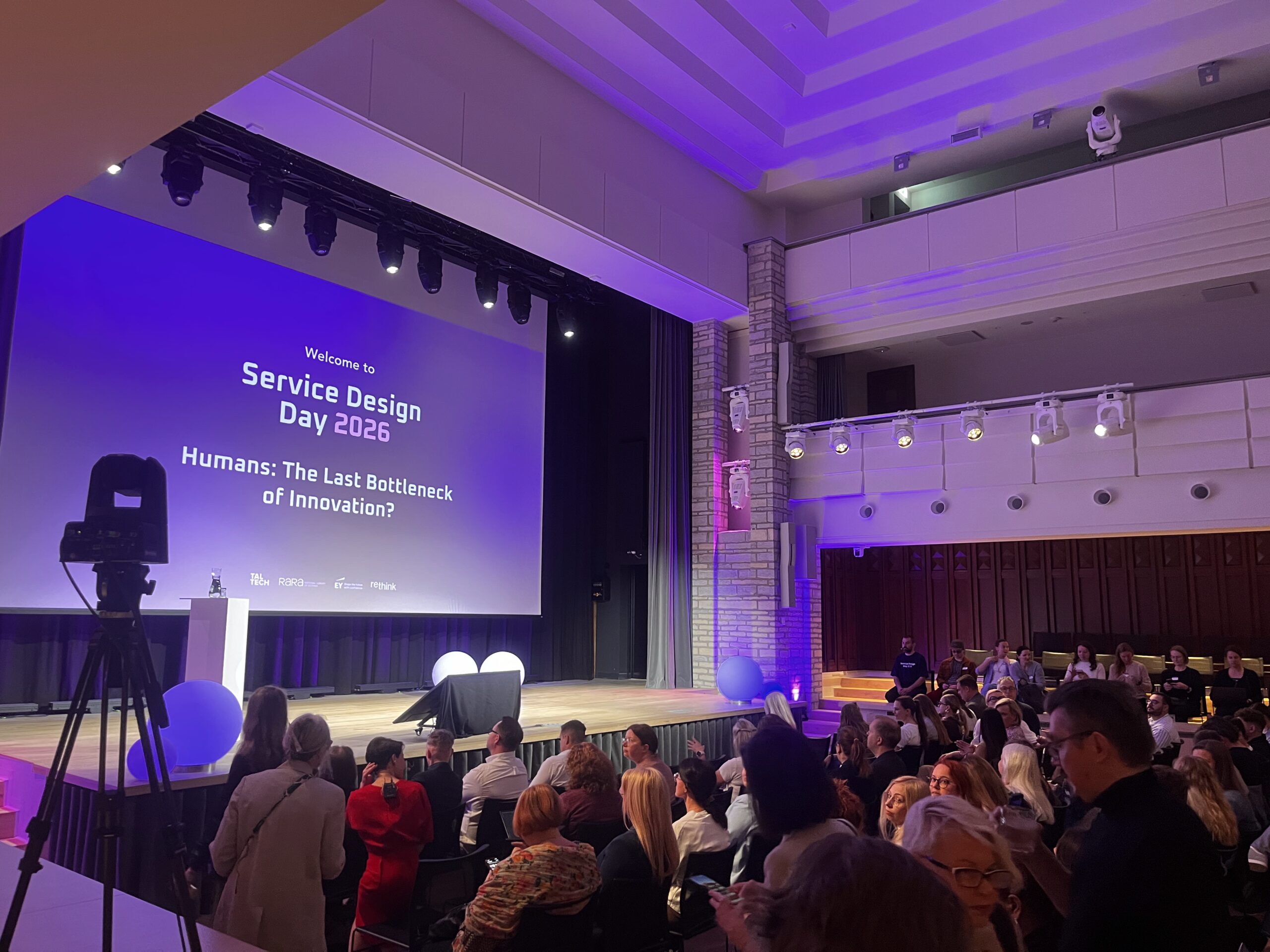
This is my third Service Design Day in a row. I keep coming back because of the quality of the content. It's one of those events where the programme alone is enough to clear the calendar. This year I got to attend with a few colleagues from SEB, which made it a different experience from previous years.
The conference was held at the National Library of Estonia, which has been closed to the public since 2021 for renovation. Full reopening isn't expected until 2027, so it was interesting to be there before public access. It was one of the larger events hosted there since the work began, and the space looked great. On the way out I also managed to borrow a book from a small selection the library had put together for the event: Redesigning Value by David Dunne, Chris Ferguson, and Paolo Korre. Given the day's theme, it felt right.
This year's theme, Humans: The Last Bottleneck of Innovation?, was one of the reasons I was looking forward to the day. The question was interesting: AI can now build faster than people, so where does that leave us? Honestly, I expected the talks to engage with it more directly. The first half of the programme touched on it only loosely. The second half got closer but overall my expectations for the theme were higher than what the day delivered. Still a great conference and the content stands on its own.
Beyond Nudges: AI and Behavioral Science at Oura
Sofia Strömmer · Behavioral Science Manager, PhD · Oura
A solid talk, and a useful reframe. Rather than presenting features, the focus was on value and what actually motivates people to change behaviour. The argument being that how you frame something matters as much as the thing itself. Reframing is a design tool, not just a communication trick.
Designing Systemic Change
Peter Fagerström · Founder · Educraftor
A useful lens for thinking about organisations: they're not machines to be optimised, they're ecosystems. Complex, interconnected, and in need of the same kind of adaptive evolution. Not the most immediately applicable talk for day-to-day work, but a good reminder of why top-down design interventions so often don't stick.
Levelling Up Design Maturity in a Complex Corporate Structure
Maria Uhari-Pakkalin · Director of Design · SOK
The most relatable talk of the day for anyone working inside a large organization. UX maturity models, how to distribute design capacity across teams, embedding designers close enough to the work that customer centricity becomes a default rather than an afterthought. Familiar territory, but presented in a grounded way. The core challenge she described, getting design taken seriously next to business goals while establishing consistent ways of working, is one most in-house designers will recognise.
Responsibility Beyond Transactions
Ville Immonen · VP of Service Design · DBS Bank
The talk explored how cultural context shapes design decisions in banking, specifically the deliberate use of friction as a protective mechanism for customers rather than something to be designed away. An interesting counterpoint to the Nordic default of removing every obstacle from the user journey. The cultural comparison between Singapore and the Nordics was a recurring thread, though at times the framing felt like it leaned a little too comfortably on Nordic design as the reference point.
The User Is Leaving the Building
Indrek Reimand · Head of Digital Channels and Design · Coop Pank

Short, direct, and one of the talks that stuck with me. The premise: AI agents are already here, and the relevant design question is no longer about interface details. It's about what happens when there's no interface at all. One of the slides put it plainly as The Agentic Value Proposition Rule: "When there is no UI, you can no longer compete on features. The product becomes invisible. The only interface left is value".
It's not a shift in what the job actually is, but a strong reminder. Less about how something looks, more about whether the underlying thing is worth anything when stripped of its presentation layer. And that was the main reason why it stood out.
Creativity in the Age of AI
Klara Leander · Nordic Managing Partner · EY Doberman
The talk I enjoyed most on the day. Coming right after the agentic AI framing from Coop Pank, it felt like a deliberate counterweight, putting the human back into the conversation.
Klara drew on examples from Journey On: Audacity, a magazine EY Doberman publishes themselves. The premise of that issue is the mindset of mavericks, the courage to step away from the expected, to follow a path of your own, and to venture where few have gone before. That same spirit ran through the talk. Let rebels be rebels. Dare to go somewhere you have nothing obvious to do, not as a productivity exercise, but as something worth doing for its own sake. The argument applied to both individuals and organisations.
In a day that spent a lot of time on AI and design maturity frameworks, this one was a reminder that none of it matters much without people willing to take an actual position on something.
What I'm Taking Back
A few things landed across the day, and some of them only connected on the way home.
Philosophy before prompts. Value before feature. Two different talks, same underlying idea: the thing you're building matters more than how you build it, and getting clear on that first changes everything downstream. With AI accelerating the execution side, that clarity becomes more urgent, not less.
Get uncomfortable to get better. Klara's talk made this feel less like advice and more like a principle worth actually acting on. I've put myself in enough uncomfortable situations to know it works. Exchange year in a country where I didn't speak the language, living abroad across different countries, still doing it. It's easy to agree with in a conference room. Harder to do anything about on a Tuesday. But that's kind of the point.
And on the theme itself, Humans: The Last Bottleneck of Innovation? I'd push back on the framing slightly. The talks that resonated most didn't position humans as obstacles to be optimised away. They positioned us as intentional friction creators, the ones who decide where to slow things down, where to protect, where to push back. That's not a bottleneck. That's the job.