Overview
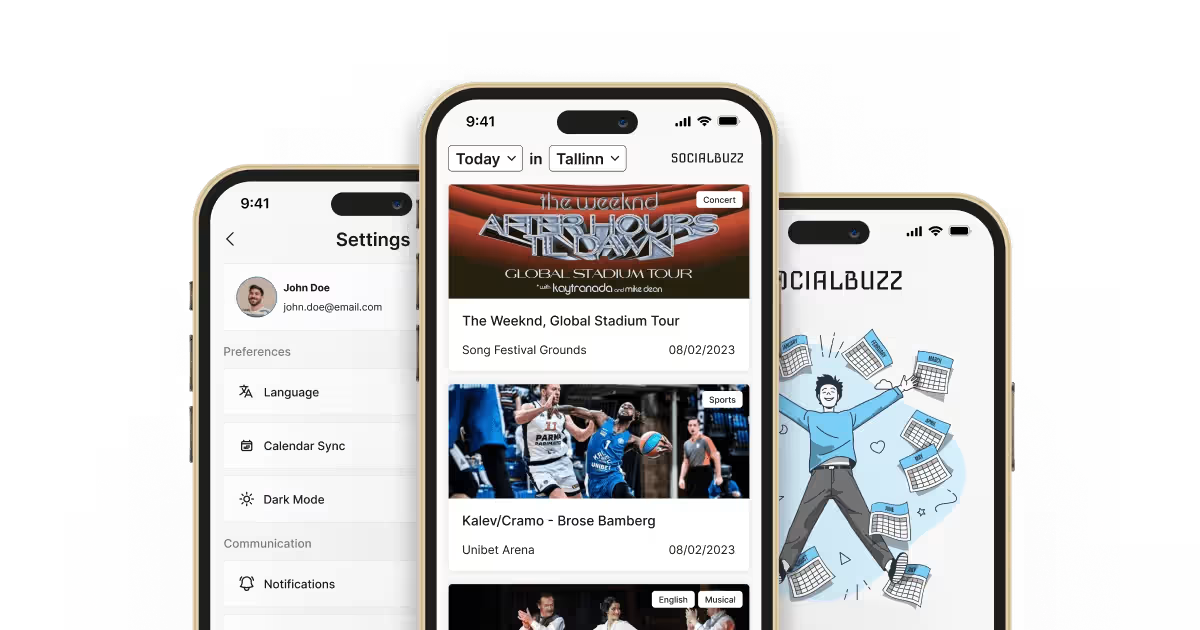
Social Buzz is a personal project exploring how to make local event discovery simpler and less fragmented. Most existing solutions require too much time and effort to find something relevant and people end up checking multiple platforms, dealing with inaccurate recommendations, and scrolling through cluttered listings with no clear way to filter what matters.
The goal was to design a focused, mobile-first event discovery experience that helps people find local events quickly, based on their location and interests.
Role: Product Designer (Personal Project)
Year: 2023
Process
Research
In order to understand the problem space, I conducted 7 in-depth interviews to uncover user preferences and pain points, and complemented this with desktop research to map out the competitive landscape.

I analyzed the data by sorting the interview answers and desktop research outcomes into an affinity map. It helped me to identify patterns and trends in the data, and provided a clear overview of the pain points and opportunities.

Through this research, I aimed to identify key user needs and expectations, as well as areas for improvement and differentiation. I found that there are various platforms available for discovering local events, but they all come with their own set of limitations. Following this, I identified and reviewed competitors to gather more information.
Pain Points and Opportunities
People are proactive in seeking out events to attend, but they dislike the current process of searching for and discovering events. They shared their negative experiences with inaccurate personalized recommendations, inaccurate suggestions based on location, and overcrowded lists where it's hard to find things. Below are the main pain points identified during the research process.
- The fragmented nature of event listings across multiple platforms makes it difficult for people to discover and keep track of all events happening in the city.
- Not all event listings are available on every platform, and in some cases, competitors may have an excessive amount of events listed (e.g. user-created or duplicated content), which makes it difficult for users to find the specific type of event they are interested in.
- People have difficulty filtering their search results to find events on mobile that match their specific interests and preferences.
- The location and time accuracy needs improvement, as people are often provided with inaccurate event recommendations.
People desire a calendar sync that would help them to organize their schedule easily.

With the pain points identified through interviews and research, there are several opportunities to improve the user experience and differentiate the solution from competitors. Here are some potential opportunities that could be explored:
Integration of multiple platforms: Providing a solution that gathers event listings from multiple sources could help alleviate the frustration and confusion associated with checking multiple platforms for events.
Enhanced filtering options: Implementing more comprehensive and intuitive filtering options would help people find events that match their specific interests and preferences more easily, making the platform more appealing.
Improved accuracy: Providing a more accurate and reliable information system could be a key opportunity to differentiate the application from competitors and provide a better user experience.
Close future events: An opportunity could be to focus on close future events by emphasizing events that are happening soon, such as within the next week or month. This could appeal to users who are looking for more immediate plans or who may be visiting a particular location for a short period of time.
Direct outreach: Creating a direct communication line between event providers (such as artists, sports teams, and venues) and users could be an opportunity. This would allow event providers to directly engage with their audience and promote their events more effectively, while also providing users with more personalized and up-to-date information. Another opportunity could be to leverage newsletters to provide people with content like discount codes and pre-sale tickets.
Learn first: Allowing people to follow event providers (such as artists, teams, and venues) and receive notifications about upcoming events without the need to proactively search for them could be another opportunity.
User Stories
To cover the full scope of the platform, I mapped user stories for three user types: event-goers, venue owners, and performers. This helped ensure design decisions worked across all sides of the product and the solution would meet the needs of a diverse user base.
Project Scope
I prioritised the end-user over other user types at this stage to keep the project focused. The decision to go mobile-first came directly from interviews; people preferred their phones for event browsing, which made mobile the natural starting point.
Design and Prototype
I mapped out the main user flows in Miro, then moved into Figma to define the visual style and build foundational components following Atomic Design principles.


Exploring the light/dark theme options, implementation was easy as the colors were defined with their use case purposes.


Some ideas for various notification types that may capture users' interest.

Reflections
This project pushed me to think beyond UI screens earlier than expected. Considering how push notifications, content aggregation via APIs, and automated data gathering would actually work made the design decisions more grounded. Looking at the problem from multiple angles, not just the end user searching for events, but also how venues and performers could use the platform, brought a business dimension to the work that I found valuable. I even explored whether a curated newsletter could serve as a leaner MVP before committing to a full app. It was a good reminder that defining the right product is as important as designing it well.
In late 2025 and early 2026 I revisited the project to experiment with AI prototyping tools Figma Make, Lovable, and GitHub Copilot. Rather than continuing the design, I used the existing concept as a sandbox to explore what these tools could and couldn't do. A low-cost way to get hands-on with how AI is changing the prototyping process.